
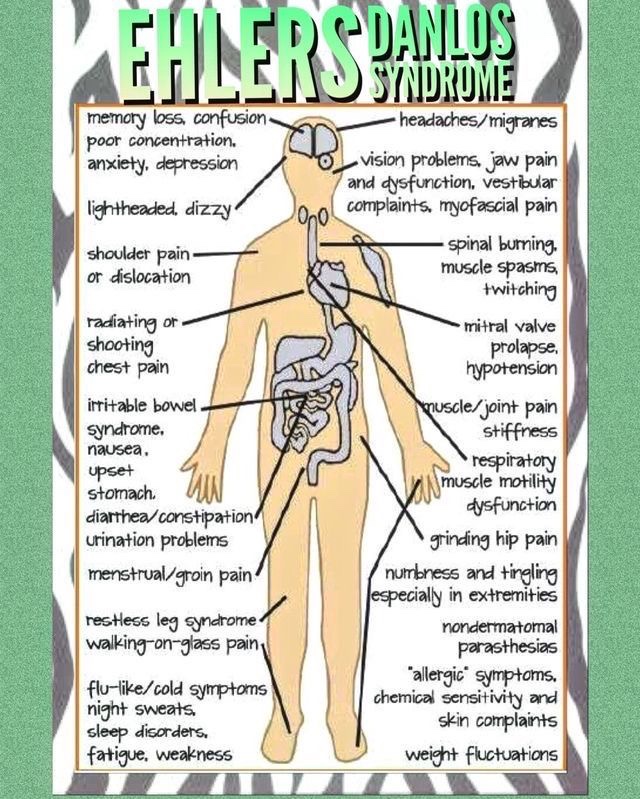
Ehlers Danlos chart, taken from Pinterest.com
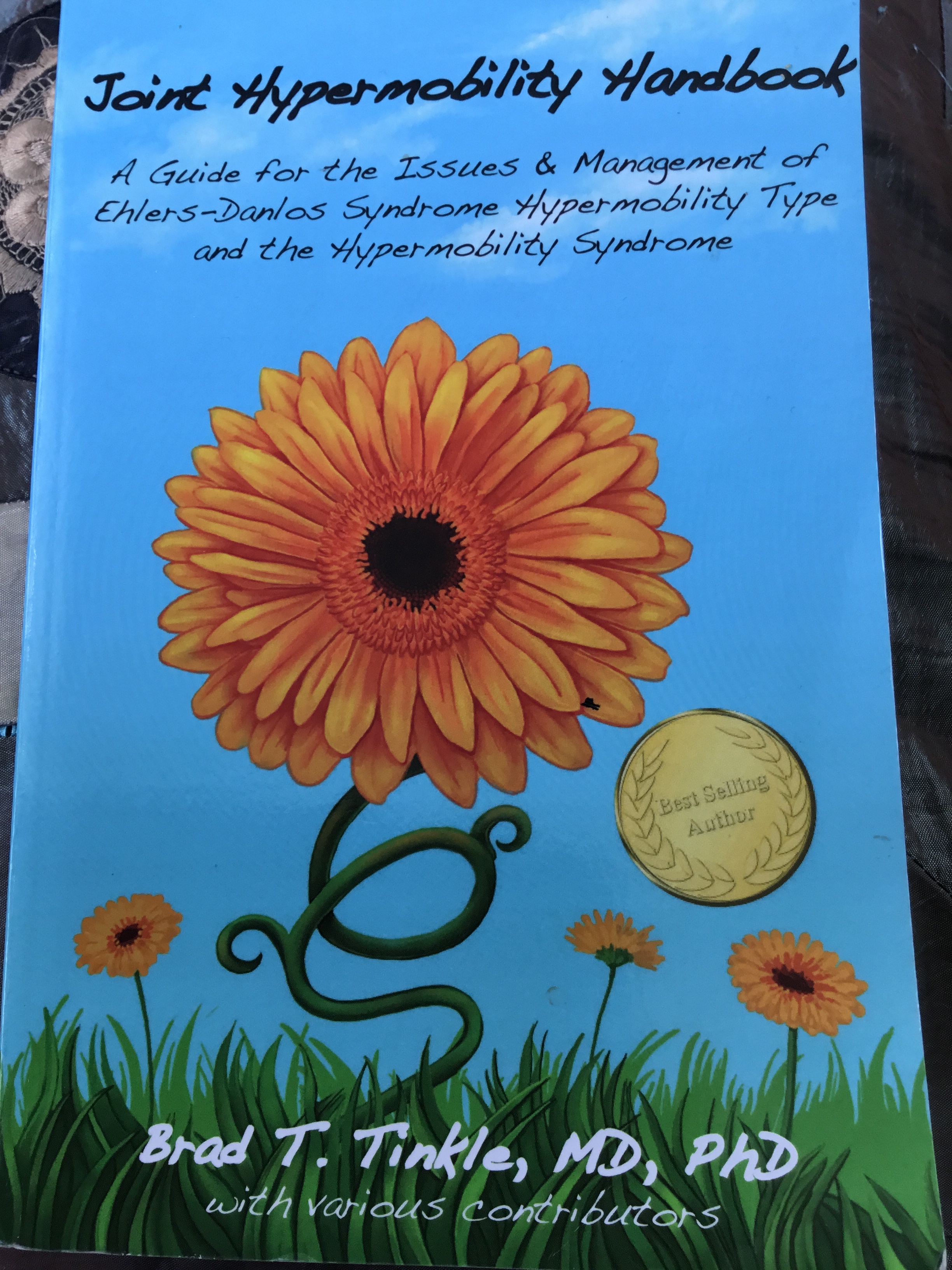
The Book Joint Hypermobility Handbook
Author(s) Brad T Tinkle, MD, PhD with various contributors
Year 2010
What it says on the back cover
As a follow up to his his previous best selling book, “Issues and Management of Joint Hypermobilty: A Guide for the Ehlers- Danlos Syndrome Hypermobility Type and the Hypermobility Syndrome,” Dr Tinkle has created this handbook with several contributors to expand insights into the understanding and management of Ehlers- Danlos Syndrome Hypermobility Type and the Hypermobilty Syndrome.
Dr Tinkle has received many accolades for his ability to take a complex condition and make it understandable in everyday language.
“provides a wealth of information about the natural history, and physical and medical management …It should be of great value to patients.”… The American Journal of Medical Genetics
Reader comments… “a useful tool in helping me obtain the type of care I need to manage my disorder …”
“This book is simple but not oversimplified. It is an excellent basic resource, giving a clear, concise, and useful overview for those (like myself) who live with hypermobility.
“Super book for EDS! Finally a book that everyone can understand.”
“… theoughly explores the problems associated with EDS-HM. It is a relief to realise that it is not just me.”
“a tremendous service for the health care community and the families and friends of those diagnosed or not yet formally diagnosed folks with EDS-HM … joy and clarity in reading the very ‘easy to read’ text chapters detailing the impact of EDS-HM…”
In addition to the wealth of positive reviews, Dr Tinkle’s previous book on the same subject was a best seller in several categories:
* General orthopedics* Medical Genetics
* Orthopedics * Family and General Practice
What made me pick up this book
My journey
The year is 2012, I have decided to return back to study to get Arts degree majoring in Social Sciences. I start my year off with all the right intentions. As I am studying extramurally again I realise that in order for me to do well I need to be self disciplined and dedicated to what I am doing. Study does not come naturally to me despite completing my tertiary studies when I was younger. I notice that my tiredness increases, my back is sorer than usual and there are parts of my body that don’t function like usual. Or what I have known to feel normal doesn’t feel as normal as it would usually.
I wrote a rather exhaustive list. Made an appointment to see my GP, a doctor who has seen me since I came back from living in Australia and Saudi Arabia and was now seeing me complete my Arts degree. He was fascinated by everything I was learning and genuinely interested in my papers I was completing.
Ian calls me in to his room from the reception. We are on a first name basis. Many of his other patients are too. It feels more personal.
“OK let’s have you up on the table” he says. He gets his little rubber mallet thingee and hits my knee. He checks my blood pressure and pulse, then he looks at my eyes and asks me to take off my glasses. He gives me the once over.
“I think I’m going to refer you to see a neurologist, I’m not sure exactly what’s going on. I will write a letter and see if we can get you a referral up at the hospital”. I thank Ian and he gives me a prescription for some of my complaints I have had. My beta blockers dosage is increased and I’m now taking another drug for my gastric reflux that supposed to be better than the old one and a new drug called Amitriptyline that supposed to help with my other issues.
Ian explains why he’s giving it to me and let him know how I get on. I do and within the next few months I receive a letter from the hospital informing me I have an appointment with the Neurology department. I go to the hospital via my town’s bus service. It’s a 20 or so minute ride in to Hamilton where the hospital is. I’m early and when I get to where I have to go my Neurologist is looking for someone that she expects to look in her forties and that would be me. Only when she calls my name she’s not looking in my direction. She’s looking for a person who might have a cane, some aid to help them. I get up and walk towards her, rather surprised my Neurologist smiles and “says you look so young for your age, umm I wasn’t expecting that”. 😊
I smile and follow her into a room. 🙂
Now I could carry on this story but basically I think you know what’s to come. My neurologist had an idea what my problem may have been and she did run a few tests namely The Beighton Score, a test used to diagnose patients with suspected Ehlers Danlos Syndrome. I then saw a Rheumatologist a short time later and together with my rather exhaustive list I had written for both my GP and Neurologist she was quick to diagnose me.
I have many symptoms, symptoms that don’t really link well together. Ones that frustrate me like bladder weakness, something I have had since I was a child. Body subluxation issues especially with my feet, legs, arms and so on. Poor vision, Brain fog, very flat feet that makes it difficult to walk at times without adequate footwear with decent arch support, dizziness when I stand up, vertigo, inner ear infections, peripheral neuropathy in my feet, hands, osteoarthritis, curved spine, stretchy skin, do I go on?
…
Yes all of that somehow helped to connect the dots to lead to my diagnosis. There’s a possibility I have Multiple Sclerosis like my Dad and it’s possible he has Ehlers Danlos like me. We have very similar symptoms.
Back to the book, cripes!
This book sets out to do what it says it will. It was great to be able to read it and identify how other people out there were coping with this disease. What it did do was to help ease some of the symptoms and the issues that they faced. I felt it was a comfort knowing that a lot of what I read, there were others out there just like me.
I also realised that I was experiencing was not a case of hyperchrondia and I was not a drama queen but real symptoms that were true and sometimes very painful like the subluxation issues I would dust off just saying my body must be getting old or something.
I felt the relief knowing that there was hope, and although there is no cure, that there it’s ok, there are people who can help you, people battling very similar issues to yourself. It was a relief to know the joy I felt after I had finished reading it.
I sometimes connect with other people online who also have Ehlers Danlos here in New Zealand and in the United Kingdom and United States. I have met a few of them in person but sometimes I feel it is too much of a sensory overload reading peoples comments online. One of the best things I found in my Ehlers Danlos journey was to never give up on life.
Keep going and be strong. I had to keep reminding myself! It sort of became a mantra.
I also took inspiration from both my parents who have suffered with their own health issues but keep fit and hardly show that they have suffered with cancer and MS. My other inspiration was a number of other people but one stood out, a teenage girl who I instantly loved when I reached out online asking if there were any others out there in my area. She reminded me of younger version of myself. I could chat to her all day and her parents as they were so supportive of her journey. My parents understand I have EDS but they know so little about it. Dad knows he has very similar issues and my late grandmother, his Mum was very supportive as she had similar issues which means she was quite likely my genetic link as EDS is a genetic condition. My Mum has tried to understand it as has Dad.
Mum was a great support this year when I was diagnosed with something else this year that prompted emergency surgery after spending the better part of last year very sick. So having a great support network is vital. My fiancé is still trying to get his head around it.
Ian my GP had retired when I got the book so I shared it with my new doctor and let him borrow it. He knew so little about EDS just like Ian and many other health professionals. With the right support and having a good ‘team’ of people who can help you is priceless. I now have a chiropractor and a naturopath/osteopath who have an understanding of EDS who I now see as well as my GP for everyday things such as my prescriptions and when I can’t see the other two.
EDS is a disease I could talk so much about. But I feel I have said more than enough.
If you are unsure about something, talk to your GP, research it and keep fighting if you don’t get a referral. I was fortunate I had a great doctor but it took almost forty years to get a diagnosis. EDS is a very hard thing to sometimes understand. But I’m seeing a lot more progress since my diagnosis. More people are aware of it.
Thank you for letting me share this side of me.
This post is dedicated to my former doctor the late Ian McCullough who was a great support throughout my journey and who passed away with cancer in October 2020. (New Zealand).
 The Bookaholic Bookworm